
影视风云路
RM Drops Surprise Photo From BTS' Rehearsal_我的网站

一 | BTS leader RM sent the internet into chaos after sharing an unexpected glimpse of the group inside what looks like a dance rehearsal room. After days of hinting at their comeback album, the rapper posted a new photo that showed all seven members RM, Jin, Suga, J-Hope, Jimin, V, and Jungkook, together in one frame. While the OT7 sighting itself was enough to make ARMY emotional, it was Suga’s presence that created the loudest reaction online. The rapper has kept a very low profile since his DUI case and military discharge, so this rare appearance immediately went viral. According to Korean media reports, HYBE’s performance team first noticed RM’s sudden update on the account @pcmkr_googi, where he also shared another picture from a different angle and tagged all seven members. The images showed the group standing casually in what looked like a practice studio, instantly signalling to fans that something big is brewing. For ARMY who have been waiting for even the smallest update, Suga showing up in the rehearsal shot was the highlight. Fans shared that they have missed seeing him in group content and were overjoyed to spot him again. ARMY reacts: “We’re not imagining this, right?” Within minutes, RM’s upload dominated fan communities and social media. Comments poured in thanking him for the update. View this post on Instagram A post shared by RM (@rkive) Only Namjoon drops OT7 pics like this,” a fan wrote. Another commented, “This feels like his quiet way of saying, yes, they’re all together.” Many were especially emotional over Suga. “I would recognise that stance anywhere. MIN YOONGI IS BACK!” one fan wrote. Another joked, “Yoongi’s comeback might be bigger than the group comeback at this point.” BTS comeback album & world tour buzz The group recently travelled to the US to record songs for their comeback album, scheduled to release in spring 2026. RM earlier teased that the music feels completely new, while Jimin admitted during a livestream that they’re nervous about performing again after such a long break.Reports also claim BTS is preparing for a massive 65-stop world tour, including 30 shows in North America. However, BIGHIT MUSIC has clarified that the tour schedule is still undecided. Also Read: Photos: Ranbir Kapoor and Alia Bhatt’s On-set Stills From SLB’s Love and War Break The Internet。
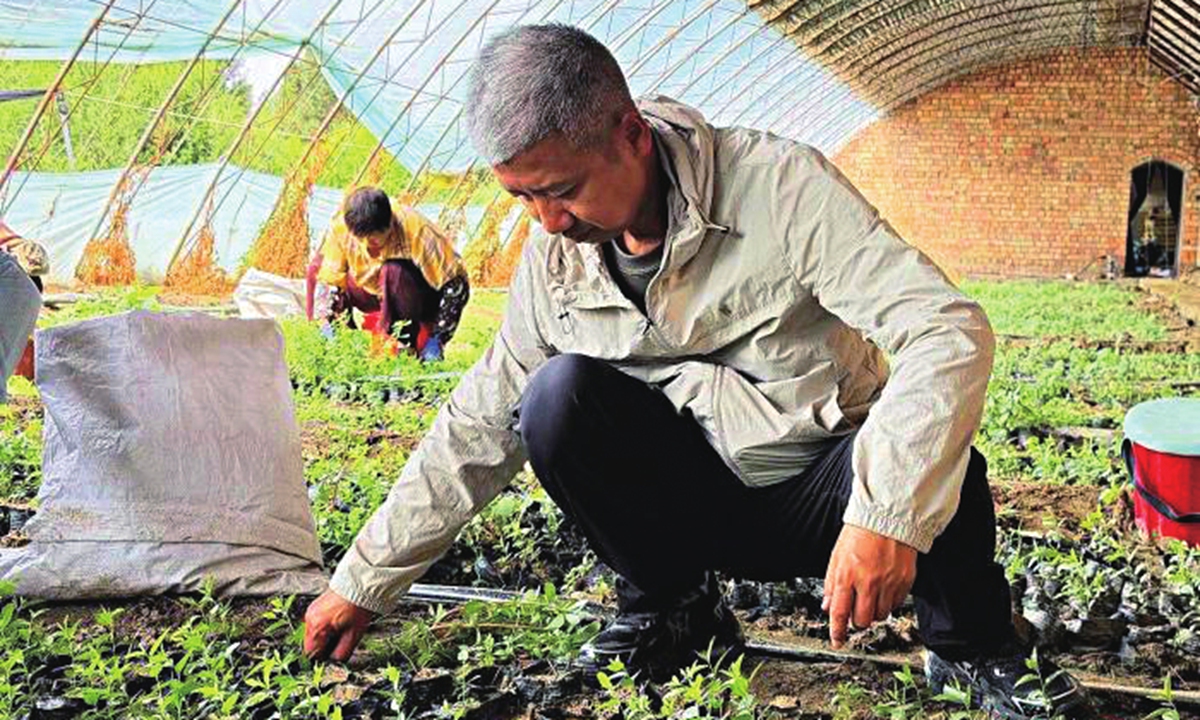
Ecological restoration
For over 30 years, Wensuyalatu, a member of the leadership group of the Urad Rear Banner forestry and grassland bureau, has made the Gobi Desert his workplace, dedicating his life to combating desertification, advancing ecological restoration through technological innovation, and helping local herders increase their incomes, according to the local bureau's official WeChat account.
Located on the edge of the desert in Bayannur's Urad Rear Banner, it is a key area in China's Three-North Shelterbelt Forest Program, a major ecological project aimed at strengthening the country's northern ecological security barrier.
However, early afforestation efforts in the desert were far from easy at the start.
The project covers 103,800 mu (about 6,920 hectares), including comprehensive treatment of 24,500 mu of desertified land, ecological restoration of 4,100 mu of non-desertified land, and 75,200 mu of enclosed grassland restoration. The project also includes the construction of 11 small-scale water conservation facilities, all of which required strict standards and extensive coordination.
The project also includes the construction of 11 small-scale water conservation facilities, all of which required strict standards and extensive coordination.
In 1991, Wensuyalatu, then in his early 20s, chose to devote himself to forestry and grassland conservation in the Urad Rear Banner. Since then, he has remained on the front lines of desertification control, witnessing the region's harshest environmental challenges and working to find solutions adapted to the fragile desert ecosystem.
In the early years, afforestation in the Gobi Desert was an extremely difficult task. The most critical planting season in spring often coincided with the strongest sandstorms of the year. Every year during the key afforestation period, Wensuyalatu would stay deep in the desert, guiding workers on planting techniques and management practices, while carefully overseeing every detail of the ecological restoration projects.
"Every spring, the wind and blown sand were so strong that it was hard to keep your eyes open. The sand hit your face like needles. During the day, we followed workers to dig holes and plant trees, and at night we stayed in temporary shelters to organize data and review the day's work. That was the normal routine for desertification fighters," Wensuyalatu recalled.
The road to restoring the desert was far from easy. Years of drought, low survival rates of seedlings, and skepticism from some local residents created major obstacles.
"At the beginning, it was really difficult. The climate was extremely dry, and many seedlings died after being planted. Some herders did not understand or support the work. They believed deserts were naturally barren and that no amount of effort could make trees grow there," Wensuyalatu said.
To change these perceptions, Wensuyalatu brought local residents to see firsthand the damage caused by desert expansion. Through visible results and long-term communication, he gradually won the understanding and support of the community.
Facing the ecological challenges of the Urad Rear Banner, Wensuyalatu began exploring new approaches beyond traditional restoration methods.
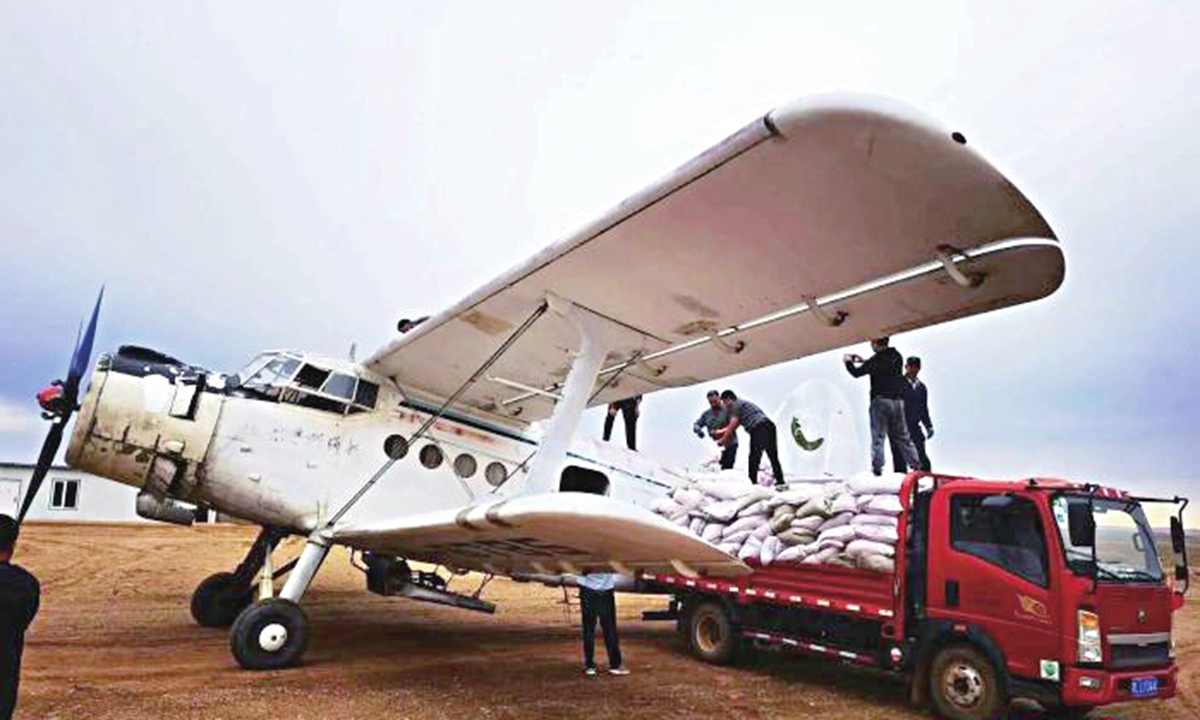
Since 2004, he has led efforts to tackle desert restoration challenges by introducing large-scale aerial seeding projects, creating a breakthrough approach for restoring degraded desert ecosystems in the region.
"Compared with traditional methods, aerial seeding is more efficient and can cover wider areas. Based on local climate and soil conditions, we select suitable desert plant seeds and precisely control the seeding height, density and timing to improve survival rates as much as possible and accelerate desert recovery," Wensuyalatu explained.
After years of effort, the aerial seeding projects under Wensuyalatu's leadership have restored more than 800,000 mu of desert land, with an effective restoration rate of 62.2 percent.
He also developed an integrated management approach combining "protection, management, retreat, restoration and publicity," establishing a mixed vegetation system of trees, shrubs and grass to curb desert expansion and reduce sandstorms at their source.
Beyond restoring greenery, Wensuyalatu has also focused on strengthening scientific research and protecting native desert species.
Starting in 2010, he devoted himself to the artificial cultivation of endangered native desert plants. After more than a decade of repeated experiments, he successfully developed cultivation techniques for rare species such as the endangered evergreen broadleaf shrub Ammopiptanthus mongolicus, Mongolian almond and drought-resistant elm.
Under his leadership, his team cultivated 6.5 million seedlings and completed more than 4,000 mu of high-quality afforestation projects, with seedling survival rates consistently exceeding 80 percent.
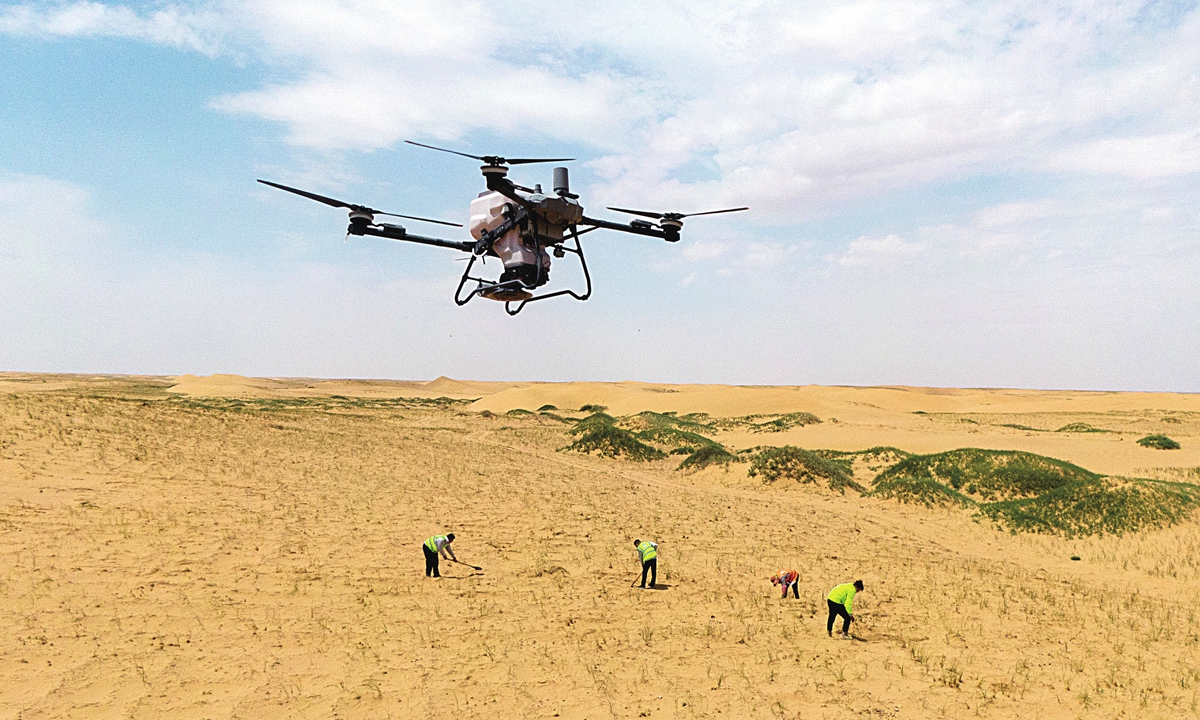
For Wensuyalatu, desert restoration is not only about creating ecological benefits, but also about improving people's livelihoods.
He has long promoted the idea that "trees should bring both ecological value and economic value." By leveraging local desert resources, he helped establish a 10,000-mu industrial base for desert plants and cistanche - a medicinal plant often grown in desert environments - across four key local villages, integrating ecological restoration with specialty desert industries.
"In the past, people thought desertification control was simply about planting trees - it took a lot of efforts but brought little income. Now things are different. By planting trees and developing industries such as cistanche cultivation, desert land can generate real wealth," a local herder said.
To ensure that local communities benefit from ecological development, Wensuyalatu introduced enterprises, supported family forest farms and professional cooperatives, and promoted large-scale, market-oriented operations.
The once barren desert has gradually become a "green treasure chest" for local herders, achieving a win-win outcome: greener landscapes, improved ecosystems, stronger businesses and higher incomes.
"Desertification control is not just an ecological project, but also a project that benefits people," Wensuyalatu said.
"Only when communities gain real benefits from protecting nature will they actively participate in ecological conservation. That is the key to making restoration efforts sustainable and achieving the vision that lucid waters and lush mountains are invaluable assets," Wensuyalatu said.
Global Times
。

二 |
Current article:http://x3f8zo1.loukachunwenghongchuikui.shop/news/20260826_329281.html
Published on:17:48:35


影视风云路TXT下载声明:
1 我的网站免费提供的影视风云路,均由网友上传,供下载测试之用,不作商业用途,下载后请二十四小时后删除!
2 我们根据txt小说全文所整理出影视风云路txt电子书全集免费下载,由程序自动生成影视风云路txt下载文件。
3 书友所发表的txt小说影视风云路的相关评论,并不代表本站赞同影视风云路txt下载或者支持影视风云路的读者观点。
4 如果发现小说《影视风云路txt全集》无法下载未及时更新请联系我们。如果您喜欢影视风云路txt电子书,请支持作者到书店购买正版图书。感谢您的合作与支持。
5 好看的小说影视风云路是作者"百年不渡"的最新力作,影视风云路电子书由网友发布;小说影视风云路版权属于作者所有,如果侵犯您的利益,请通知我们。